
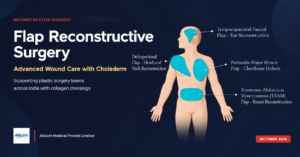
Flap Reconstructive Surgery: Wound Care Principles and the Role of Collagen-Based Dressings
Flap reconstructive surgery — in which tissue, along with its blood supply, is transferred to repair complex defects — represents one of the most technically demanding areas of plastic and reconstructive surgery. Whether used to close defects following tumour resection, trauma, burns, or chronic wounds, the success of a flap depends not only on the...
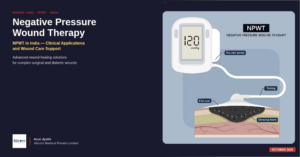
Negative Pressure Wound Therapy (NPWT): Clinical Applications and Product Overview
Negative Pressure Wound Therapy (NPWT) in India: A Clinical Overview for Healthcare Professionals Wound management has evolved considerably in recent decades, and Negative Pressure Wound Therapy (NPWT) has become a significant modality within that evolution. Used across tertiary hospitals, specialty wound care clinics, and increasingly in outpatient settings, NPWT offers a mechanism for managing complex...
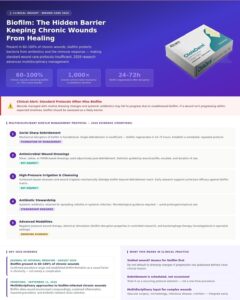
The Biofilm Problem: Why Chronic Wounds Resist Standard Treatment — and What 2026 Research Reveals About Better Approaches
Chronic wounds — defined generally as wounds failing to progress through normal healing stages within four to twelve weeks — represent one of clinical practice's most persistent challenges. Pressure injuries, diabetic foot ulcers, venous leg ulcers, and post-surgical complications collectively affect millions of patients and represent significant clinical burden.At the centre of many treatment failures...
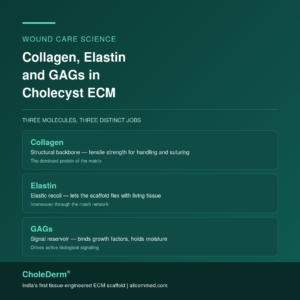
Collagen, Elastin and GAGs in Cholecyst ECM
A closer look at the three core building blocks that give cholecyst-derived matrix its regenerative propertiesIntroductionNearly every property that makes an ECM scaffold clinically useful — its strength, its flexibility, its ability to signal cells and hold onto growth factors — traces back to three families of molecules: collagen, elastin, and glycosaminoglycans (GAGs). Cholecyst-derived ECM...
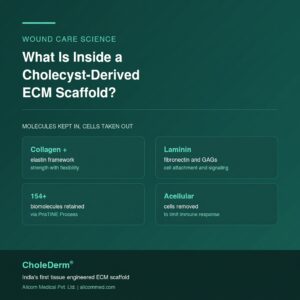
What Is Inside a Cholecyst-Derived ECM Scaffold?
IntroductionHospital clinicians and procurement teams often ask a simple question about any biological scaffold: what exactly is in it? For a cholecyst-derived ECM scaffold, the answer is a purposeful one. The goal of manufacturing is to keep the matrix's structural and signaling molecules and to remove the cells that would provoke an immune response.The Structural...
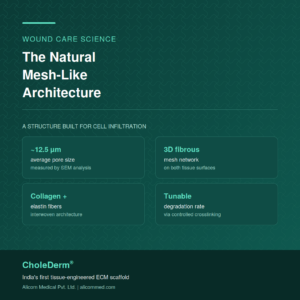
The Natural Mesh-Like Architecture of Cholecyst ECM
Why the physical structure of a scaffold matters as much as its biochemistry — and what researchers found when they looked closely at gallbladder-derived matrixIntroductionA scaffold's chemical composition — its collagen, elastin, and glycosaminoglycan content — only tells part of the story of why a biomaterial supports regeneration. Equally important is its physical architecture: how...
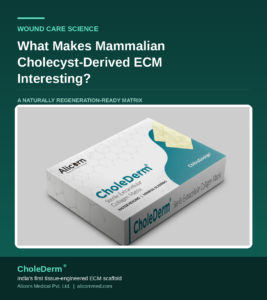
What Makes Mammalian Cholecyst-Derived ECM Interesting?
The compositional and structural properties that turned a gallbladder wall into a validated regenerative biomaterialIntroductionNot every tissue makes a good scaffold. For an extracellular matrix (ECM) to function as a regenerative biomaterial, it needs a specific combination of properties: the right structural proteins, a matrix that survives decellularization intact, mechanical strength suitable for handling and...
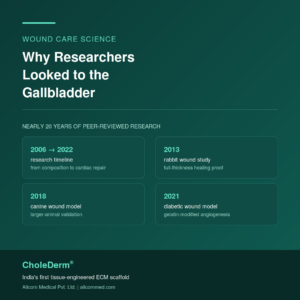
Why Researchers Looked to the Gallbladder for a Biological Scaffold.
The story behind an unlikely organ that became one of tissue engineering's most versatile scaffold sources — and the science now underpinning CholeDerm®An Unlikely Starting PointWhen tissue engineers began searching for a natural extracellular matrix (ECM) source for regenerative scaffolds, most attention went to organs and tissues with obvious appeal — skin, small intestine, urinary...
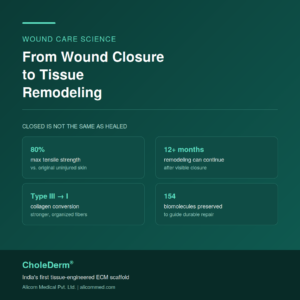
From Wound Closure to Tissue Remodeling: Redefining the Endpoint of Wound Care
IntroductionFor decades, wound care has been measured against a single milestone: closure. A wound that has re-epithelialized — skin has grown back over the defect — is typically recorded as "healed" on a discharge summary. But clinicians who manage chronic wounds, burns, and complex surgical sites know this milestone tells only part of the story....
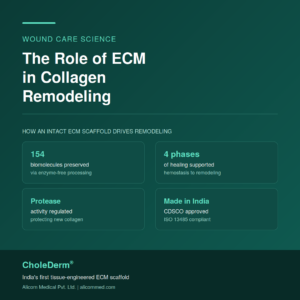
The Role of ECM in Collagen Remodeling: A Clinical and Commercial Case for Advanced Wound Care Protocols
Why hospital wound care and surgical departments are re-evaluating collagen remodeling science — and what it means for procurement decisions in 2026IntroductionCollagen remodeling is the phase of wound healing that determines whether a wound closes with a functional, low-scar outcome or lingers as a chronic, non-healing ulcer. For corporate hospitals managing high patient volumes across...
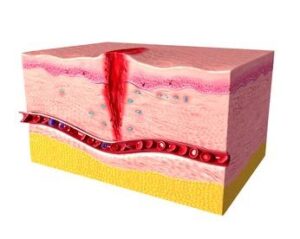
How ECM Supports Re-epithelialization
Key TakeawaysRe-epithelialization depends on coordinated cell movement, attachment, proliferation, and communication across a healing wound. ECM can support these events when its structure, composition, processing, and clinical use are appropriately matched to the wound environment.Epithelial cells must migrate from the wound edges and rebuild a continuous surface.ECM provides both a physical scaffold and biochemical signals...
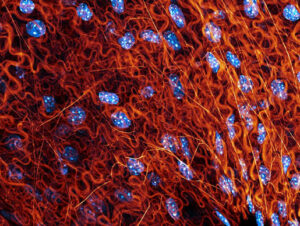
ECM and Cell Migration During Wound Repair
Key TakeawaysECM and Cell Migration During Wound Repair are closely connected: cells need both a path to follow and signals that tell them where to go. The quality of that local environment can shape whether repair progresses or stalls.Cell migration brings immune cells, fibroblasts, endothelial cells, and keratinocytes into coordinated repair.ECM structure provides attachment points,...