
Advanced Wound Care: When to Use Antimicrobial Dressings vs. Standard Dressings
🩹 Wound Care · Clinical Practice · Advanced Dressings Collagen vs. Synthetic Wound Dressings: Which One Does Your Patient Need?…

Advanced Wound Care: When to Use Antimicrobial Dressings vs. Standard Dressings
🩹 Wound Care · Clinical Guide · Infection Management Advanced Wound Care: When to Use Antimicrobial Dressings vs. Standard Dressings…
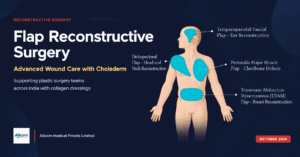
Flap Reconstructive Surgery: Wound Care Principles and the Role of Collagen-Based Dressings
Flap reconstructive surgery — in which tissue, along with its blood supply, is transferred to repair complex defects — represents…
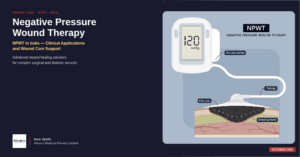
Negative Pressure Wound Therapy (NPWT): Clinical Applications and Product Overview
Negative Pressure Wound Therapy (NPWT) in India: A Clinical Overview for Healthcare Professionals Wound management has evolved considerably in recent…
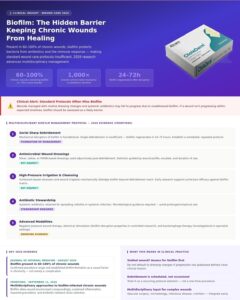
The Biofilm Problem: Why Chronic Wounds Resist Standard Treatment — and What 2026 Research Reveals About Better Approaches
Chronic wounds — defined generally as wounds failing to progress through normal healing stages within four to twelve weeks —…
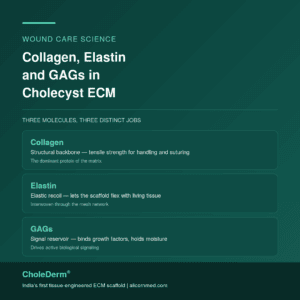
Collagen, Elastin and GAGs in Cholecyst ECM
A closer look at the three core building blocks that give cholecyst-derived matrix its regenerative propertiesIntroductionNearly every property that makes…
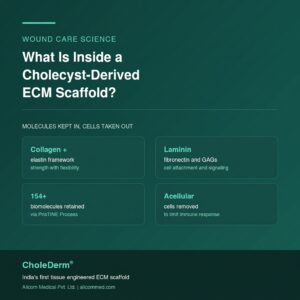
What Is Inside a Cholecyst-Derived ECM Scaffold?
IntroductionHospital clinicians and procurement teams often ask a simple question about any biological scaffold: what exactly is in it? For…
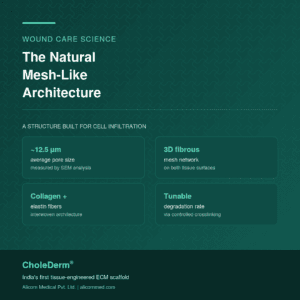
The Natural Mesh-Like Architecture of Cholecyst ECM
Why the physical structure of a scaffold matters as much as its biochemistry — and what researchers found when they…
What Makes Mammalian Cholecyst-Derived ECM Interesting?
The compositional and structural properties that turned a gallbladder wall into a validated regenerative biomaterialIntroductionNot every tissue makes a good…
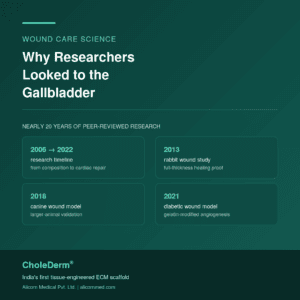
Why Researchers Looked to the Gallbladder for a Biological Scaffold.
The story behind an unlikely organ that became one of tissue engineering's most versatile scaffold sources — and the science…
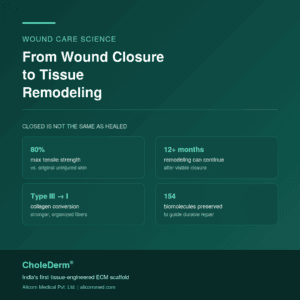
From Wound Closure to Tissue Remodeling: Redefining the Endpoint of Wound Care
IntroductionFor decades, wound care has been measured against a single milestone: closure. A wound that has re-epithelialized — skin has…
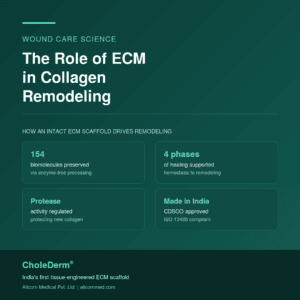
The Role of ECM in Collagen Remodeling: A Clinical and Commercial Case for Advanced Wound Care Protocols
Why hospital wound care and surgical departments are re-evaluating collagen remodeling science — and what it means for procurement decisions…

How ECM Supports Re-epithelialization
Key TakeawaysRe-epithelialization depends on coordinated cell movement, attachment, proliferation, and communication across a healing wound. ECM can support these events…

ECM and Cell Migration During Wound Repair
Key TakeawaysECM and Cell Migration During Wound Repair are closely connected: cells need both a path to follow and signals…

How ECM Provides a Microenvironment for Healing Cells
Key TakeawaysECM is more than a structural layer: it creates a changing local environment that helps healing cells attach, move,…

Why Glycosaminoglycans Matter in Regenerative Medicine
Key Takeaways Glycosaminoglycans help turn the extracellular matrix from passive scaffolding into an active environment for repair. GAGs hold water…

The Role of Elastin in Skin Repair
Key TakeawaysElastin is one part of a larger biological system that helps skin move, resist stress, and recover after injury.Elastin…

Why Collagen Alone Is Not the Whole Story in Wound Healing
Key TakeawaysCollagen is central to repair, but it works within a larger biological system. Understanding that system helps you choose…

How ECM Guides Tissue Repair
Key Takeaways Your extracellular matrix does far more than fill space around cells. It provides structure, stores biological signals, and…

What Is Extracellular Matrix and Why Does It Matter in Wound Healing?
Introduction Diabetes mellitus (DM) is a systemic metabolic disorder which is characterised by hyperglycaemia. Over half a billion people are living…

Biomaterials for chronic wound treatment: Types, benefits, and clinical considerations – English
Key Takeaways Biomaterials can help you create a wound environment that supports moisture control, tissue protection, granulation, and repair, but…

CholeDerm wound dressing: A clinical guide to its uses, benefits, and application – English
Key Takeaways CholeDerm wound dressing is a lyophilised, unmeshed acellular dermal matrix intended for use as part of a structured…

Advanced wound care treatment – English
Key Takeaways Advanced wound care treatment is a coordinated process that addresses the wound itself, its cause, and the patient’s…

acellular dermal matrix – English
Key Takeaways An acellular dermal matrix is a biologic or engineered scaffold used to support tissue repair and reconstruction. Its…

enzyme free tissue decellularization – English
Key Takeaways Enzyme free tissue decellularization uses physical and osmotic steps to remove cellular material while seeking to preserve the…

CholeDerm wound care – English
Key Takeaways CholeDerm wound care involves more than placing a dressing over an injury. You need a wound assessment, a…